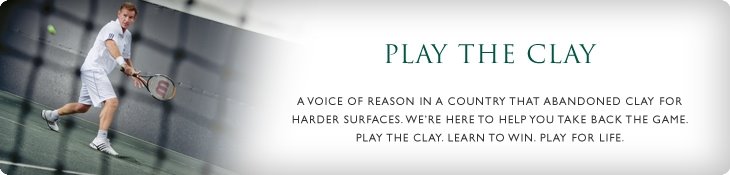
The last few days, I have had the pleasure of playing tennis at three different clay court facilities in central Italy, and for a clay court junkie such as myself, it has been a real education.
Without a doubt, there is something special for an American to hit balls on “the dirt.” The red clay in Italy is more “powdery” than the Har-Tru we offer in the US and makes a very different sound under foot as you play. It is, for lack of a better word…a sexier surface. But like a flashy Italian sports car that spends a lot of time in the repair shop, it is not without its issues. Even after a wonderful two days, I still don’t think it is as good as the green stuff back home and here is why…
1. The Dirt is Dirty – This is coming from a guy that didn’t shower for 10 straight days in college…and I lost the bet to my roommate, which stunk in more ways than one. Anyway, I now know why so many of the Europeans where grey or black socks and dark colored tennis gear. I always thought there sense of style was poor, but “tennis whites” on a red clay court is not a good idea. I will have to throw the white sox I had on today in the trash. There is no way my wife would allow them back in the house.
2. The Dirt is Inconsistent – One of the better points of a Har-Tru court is that it plays fairly similarly when it is really wet or nearly dry. The dirt…not so much! On one half of one court, the surface played at least 4 different ways. From hard-and-fast to wet-and-gummy; the courts were a little bit of everything all wrapped into one. And on top of that, they had been hand watered in an effort to make them as consistent as possible.
3. The Dirt is Mobile – We saw a good bit of accumulation due to wind and water erosion. In fact, I heard a story about a private club near Roland Garros in Paris where the housewives who lived around the courts raised so much hell, that the club had to remove the red clay courts. Want to know why? Because the clay was so fine and powdery on top that when the wind blew and the courts dried out, all there laundry would have a red haze from the “dirt” settling on it while the clothes hung in the backyards to dry. I would have gotten tired of double and triple washing my laundry as well.
4. The Dirt is Expensive – A ton of red clay topdressing costs about $200 Euros ( a little over $300 USD) plus the freight to get it there. Har-Tru is usually about half the cost…and since the red clay washes and blows away easier, they have to put down more each year than the clubs in the US.
Now I admit that I may be a bit partial on this subject, and I would be lying if I said I didn’t have a great time playing on the dirt, but for all of you in America who yearn for real red clay, watch what you wish for … ‘cause you might just get it.
It may be more exotic, more sexy, more traditional, but I will happily look forward to next week, when I get to play on good ‘ole green Har-Tru in my beloved USA again.
Arrivederci!
Randy Futty
General Manager
Lee Tennis
Wednesday, October 28, 2009


Tuesday, October 20, 2009
Tennis and Social Media
Tennis has been enjoying significant growth in the last 8 years and is the only traditional Sport to do so in that time period. We know there have been many efforts within the Tennis Community to grow the game and we have tried to do our part to support these efforts. Lots of innovative new programs have evolved like Cardio Tennis, Tennis Welcome Centers, Quick Start Tennis and of course the continued emphasis on league play with teams forming up through local clubs and community tennis associations. This is the largest growth in the game since the tennis boom of the late sixties and early seventies when tennis grew to 34 million players. Tennis was something that most young people did which was part fad and part “just the thing to do”. Courts sprang up all over the place and most places know for recreation were into tennis and had facilities available. Being in the court building business, this time was great for business but hectic as well, as the pressure to get facilities on the ground was intense. A lot of this was driven by the convergence of Tennis on TV and the personalities of those who played the game back then and the success of Americans in the Tennis World. The bottom line is that the baby boomers through the attraction of the game itself and the social media of the time, TV, made Tennis the sport it is and drove the infrastructure of Tennis Facilities that created the play opportunities that many of us enjoyed for many years.
More as an assumption for comment that a conclusion I think it interesting that Tennis which is a social sport to start with, is making its comeback during the rise of the Y generation and the media of the day which is electronic social media. Many of the initiatives of the Tennis world, although driven by people in the end, have been introduced and spread electronically which happens to be the media of the day for the Y generation. As you look at websites, facebook and twitter you also find a crossover to baby boomers as well, who happen to be the fastest growing segment in facebook right now. The irony of all this is that it comes back to Tennis’s social aspects and its adaptation to the modern form of communication that may have converged to help Tennis regain its momentum and once again become “just the thing to do”. I don’t want to sell the game short here as in the end it is always about the game itself and the fact that it is a great way to combine athletics, fitness, competition and socialization. I do think it ironic that because those in the game have had the foresight to adapt to modern media and have taken advantage of the new forms of social communication that Tennis has grown through the process.
I think we can draw two conclusion at least partially from all this conversation: Tennis is a great game and given the right exposure it will always have its place in the recreational activity world. The second conclusion is that if you’re not keeping up with the way folks are communicating your falling behind and to keep our sport viable we have to stay on the cutting edge. That is true with any industry or organization and I hope we will continue to be diligent in the area. Your thoughts are appreciated.
Monday, October 12, 2009
Got Advocates?
The opportunity to blog here could not have come at a better time. I spent the last 3 days at the ACAC Tennis Academy in Charlottesville, VA. What I experienced there with Tennis Director Jason Grigg and his assistant Dan Manilla brings to mind Kouzes and Posner’s classic work “The Leadership Challenge”. In it the authors discuss 5 exemplary principles of leadership, “modeling the way”, “inspiring a shared vision”, “challenging the process”, “enabling others to act” and “encouraging the heart”. To this end, these guys truly exceeded my expectations. I was inspired, challenged, pushed and encouraged into incremental improvement. All that knowledge and work in a short period of time was like drinking from a fire hose. The extra strength pain reliever came in handy Saturday and Sunday.
This experience only reinforces my belief in just how much of an advocate or “key influencer” the Teaching Tennis Professional is or can be, on and off the court. Advocates provide necessary stimulus to make change happen in any organization. I have seen this through our Facility Analysis Services work at over 150 clubs all over the US in the past 5 years. This opportunity has provided a first-hand glimpse into the advocates behavior. One common denominator I see for making enduring change happen is “sustained advocacy” by the Teaching Professional. This advocate also inspires others to the same enduring cause, like developing a master plan that ensures the long-term success of the tennis program and the facility where the game is played.
The Teaching Professional has the most knowledge of where the facility and the program are now and where they could be in the future. That knowledge is difficult to forge into a vision without the help of other advocates. And although some advocates “emerge” on their own, some need to be identified and recruited from the court. And we all know there is precious little time to waste on this effort.
When you think of all the committees in your organization and the fact that most people rotate off every few years, you begin to feel like one of the few “constants” in the organization. I feel that everyone who plays the game has the potential to be an advocate in some way. How has inspiring a shared vision, challenging the process, encouraging the heart and enabling others to act worked for you?
Ed Montecalvo
Consulting Services Manager
Lee Tennis Court Products
Thursday, October 8, 2009
Three Wrongs and a Black Eye for Tennis
Just a few weeks ago I expressed that officiating in tennis needed an overhaul. The phantom foot-fault call on Serena reinforces my view point. You are officiating in the most highly viewed tennis tournament there is and you are going to make a foot-fault call that is not conclusive on video replay? Are you serious? Now you can argue that the lady lines person deserved to be working on the main stage, but I’m not buying it! We have a philosophy in football officiating called the Whale philosophy, which means you catch all the whales, but let the minnows go. Basically make sure your calls are big and show up on tape.
I could ramble on forever on the poor officiating in tennis, but my focus point is on the reaction to the call by Serena. Was her behavior wrong? Was the punishment enough? I’m on the fence with her reaction. I think she had every right to show her displeasure with the horrible call. I do not believe she had the right to make a threat such as she made. I’m all in favor of her screaming and yelling and even calling the official bad names, but a threat is unacceptable. If a basketball coach came out on the floor and told the ref that he was going to shove the ball down his throat, what do you think the punishment would be? It would probably cost him his job! I’m not saying that Serena should be banned from WTA events, but the punishment she received was a joke! A $10,000 fine and a half hearted apology.
The unfortunate part of all this is that two great weeks of exciting tennis and some wonderful story lines, is all over shadowed by three wrongs! A wrong call by the official, a wrong reaction by Serena, and a wrong punishment for her reaction, leaves tennis with a black eye during the last major event of the season. Not the perfect ending for the game!
Tracy Lynch
Wholesale Accounts Manager
Lee Tennis Court Products
Thursday, October 1, 2009
Wait for it...clay courts for junior development are on the way
I wonder if the rest of the country is seeing the tennis world and specifically the future of US tennis the way I have perceived it the last year or so. To me, it seems as if the country is on the cusp of experiencing a shift in thinking about how we need to develop players. The change of thinking involves using clay courts to develop junior talent.
On the east coast of the US, clay courts have always been part of the makeup of most clubs and most tennis players are familiar with the American, green clay, (which is really a crushed stone) called Har-Tru. This surface facilitates development of a player by providing many different aspects of play that allow a player to develop patience, a variety of shots and strategies, and an understanding of the court and angles to play and win points.
But you know all that already, right? You might, but there are a lot of folks out there who don’t realize how much the type of surface contributes to the type of player you become. If we take the hypothetical example of developing two players; one grows up on clay courts and one grows up on hard courts and all other factors equal, how would the players develop? We may not be able to do this experiment, but I know the clay court player would have a variety of shots and a better sense of balance and movement than our hard court player. How do I know? Because this experiment has been happening since tennis became a world wide sport. Many, if not most of the top players in the world, grew up on clay. If you look at the year end rankings for men since they were kept, 103 made it into the top ten. Of those 103 that made it, 91 of them grew up on clay or spent at least half of their formative years on clay. If you believe that each one of these players received great coaching and had a great desire to win, the surface becomes the variable and an undeniable difference.
I have seen this evidence many times over in the past year. Clay courts are a part of almost every conversation of developing players. At the recent USTA Tennis Teachers Conference, in the opening session with Patrick McEnroe, Darren Cahill, and Brad Gilbert, all three of them mentioned the importance of clay. Other actions such as the hiring of Jose Higueras by the USTA to be in charge of coaching and the statements recorded in various articles all lead to the same fact; clay courts are great for developing talent. One article that explains the trend was in USA Today; it can be found at http://www.usatoday.com/sports/tennis/2008-11-05-USTA-overhaul_N.htm
The best article I have found that explains the concept of developing juniors on clay was published in the Wall Street Journal. That article can be found at http://online.wsj.com/article/SB10001424052970203771904574177702269085642.html
Will the US be able to produce more top players in the future? Will clay courts be a part of that? I hope the answer is yes to both of them. We want to give our players the best chance to compete and learn and clay courts are a big part of that.
Sunday, September 13, 2009
Serena Needs to Deliver a Real Apology
Serena's outburst last night was highly uncharacteristic. She has absorbed more than a few uncomfortable and unfair situations handling herself with grace and class. Clearly losing in this semifinal was hitting a very raw nerve because she lost it worse than anything I have ever witnessed at a grand slam.
I should state that I wish the foot fault had not been called. If it was terribly blatant that would be one thing, but at that stage in the match umpires and line judges should do their best to allow the match to be decided by the players. Football and basketball officials work very hard at this and a little coaching for tennis officials may be in order. But that being said, Serena's outburst was unfair to the line judge, unfair to the fans and bad for the game. Its been front page news on the internet and, on a day of incredible college football games, it was the lead story on ESPN. Her expletives, despite being bleeped, were heard all around the world and will continue to be heard for months to come. That's one spotlight our game could do without.
Part of me empathizes with Serena. I have had my share of shameful outbursts on a tennis court, however one thing I have always striven to do is to apologize completely and take ownership for my behavior. It doesn't make the behavior right but it does help people to give you the benefit of the doubt, especially when you have a good track record to begin with. This is why I was very dismayed to hear the statement issued by Serena. I quote here:
"Last night everyone could truly see the passion I have for my job. Now that I have had time to gain my composure, I can see that while I don't agree with the unfair line call, in the heat of battle I let my passion and emotion get the better of me and as a result handled the situation poorly. I would like to thank my fans and supporters for understanding that I am human and I look forward to continuing the journey, both professionally and personally, with you all as I move forward and grow from this experience."
Am I the only one who thinks this sounds like it came right from her publicist? Not only that, but it appears that the publicist was forced to compromise as Serena didn't really want to say she was sorry at all. From the post match interview to this farce of an apology, she has taken on the air of the victim rather than the perpetrator. That is incredibly disappointing to me, and I expect to many of Serena's fans, because I expected better of Serena. She has been so classy despite all the adversity she has faced that I was sure she would work hard to make this right but so far its the exact opposite. I hope she is suspended (if the US Open had real courage they would suspend her from the doubles final) and fined to a much greater degree. Its important for the governors of the sport to stand up for what's fair and what's right. I hope before its all said and done Serena will to.
Pat Hanssen
Director of Sales
Lee Tennis Court Products
Saturday, August 15, 2009
Balance
Recently, while on a business trip to the Chicago-land area I experienced a great moment of learning.
My work week was scheduled pretty full. Club visits, contractor dinners, and vendor meetings are par for the course each year; leaving little free time. But this year was different, I found myself with an open afternoon, and knowing I had a USTA league match the Saturday morning of my return, I decided I would find a local tennis club and take a tennis clinic.
So when you are on the road and have no idea where the best or most easily accessible place to go play tennis is, I did what most people would do … I went to the internet and typed “G-O-O-G-L-E.” A simple keyword search for “West Chicago Indoor Tennis Courts” turned up over 1.3 million choices.
Lucky for me, one of the listing was familiar; The Wheaton Sports Center. I had been there on last year’s trip and knew they had both indoor hard and clay courts. So after clicking on their listing and visiting their website, and I was in luck. The club offered daily clinics called “Penn’s Drills.”
Drills? How great I thought. A tennis “drill instructor” working me for an hour … I could only image the teacher … a super fit, middle-aged, ex-marine drill sergeant in a camo t-shirt two sizes too small, yelling instructions at me for an hour. I could almost hear the “jarhead” as I quickly changed in to my tennis clothes. “Bend your knees soldier, follow through on that backhand, my mother used to hit me harder than that for not eating my vegetables…drop and give me 50, fat-boy.”
Sweet I thought, a killer workout and some tough love, just what I needed to jump start my game and breakup a business trip. But what I got was nothing of the sort … except for the killer workout.
I arrived at the club, paid my guest and clinic fee and proceeded to the court to meet Sergeant Penn.
I was the first one on the court, and soon was joined by a quiet, fit gentleman in his mid-60’s. The two of us spoke for a minute or two and then “Penn” entered the court pushing her teaching cart. She was no “jarhead” … she appeared to be in her mid-50’s, walked with confidence, and had a wonderful ease about her.
An hour later, I was drenched in sweat and a better player and person based on her teaching. In no way was she a drill sergeant, but the subtle messages she offered have since been ingrained into my head and in my life.
Her main message – you need to find better balance.
Her game was ultra-smooth, her footwork flawless, always in the right position, and the precision of her ground strokes and crispness of her volleys seamed effortless…she had impeccable balance in her game and in her manor.
After leaving the club that day, I realized that finding balance may be a true key to life...and certainly my tennis game. Whether it be through fitness, footwork, awareness, caring, preparation, learning, repetition…finding balance is ultra critical to our success.
Mrs. Penn was quite profound in her teaching of me that day. Since then, I have committed to finding better balance…balance in my job, with my family, and least importantly, with my tennis game.
Thanks Mrs. Penn!
Randy Futty, the General Manager for Lee Tennis, is an avid player who plays for the 4.0 USTA team at the Boar's Head Sports Club in Charlottesville, VA.
Subscribe to:
Posts (Atom)